

Truck owners around Katy ask a lot from an all-terrain tire. A normal week can include I-10 commuting, stop-and-go traffic near the Grand Parkway, wet roads after a Gulf Coast downpour, construction zones, ranch roads, and weekend trips outside the Houston metro.
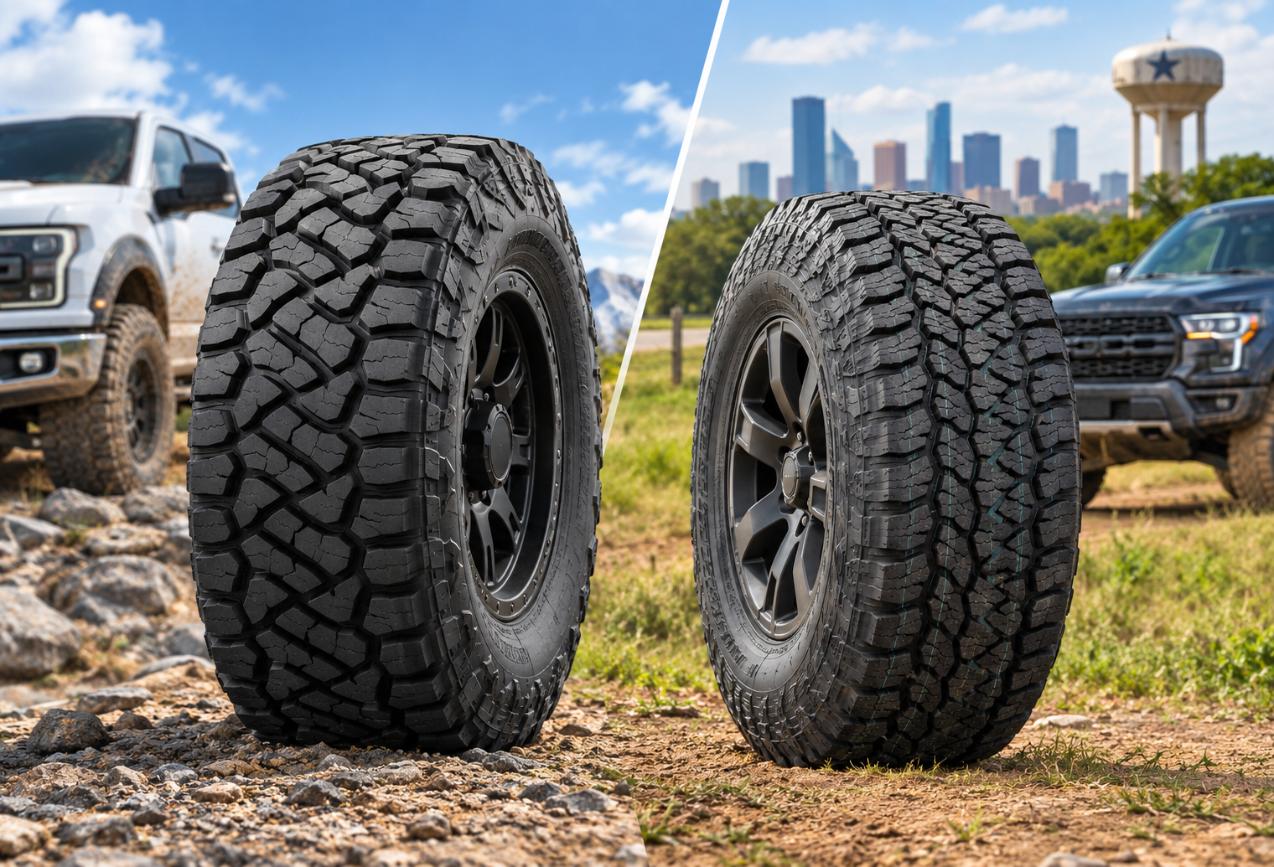
The BFGoodrich All-Terrain T/A KO3 and Falken Wildpeak A/T4W are both designed for drivers who want on-road usability without giving up off-road capability. The better choice depends on how you use your truck, especially how much you prioritize rugged terrain performance versus everyday road manners.
Quick answer: For Katy truck owners, the BFGoodrich KO3 is a strong choice for drivers who prioritize rugged off-road capability and durability, while the Falken Wildpeak A/T4W is worth considering for drivers who want an all-terrain tire that also spends substantial time on pavement. Neither tire is automatically better for every truck. Vehicle weight, tire size, towing habits, driving surfaces, and preferred ride characteristics should guide the final decision.
What Katy truck owners should know
-
Both the BFGoodrich KO3 and Falken Wildpeak A/T4W belong in the conversation for trucks that split time between pavement and rougher surfaces.
-
Wet-road performance matters locally because heavy rain can quickly change driving conditions across Katy and western Harris County.
-
Drivers traveling between Katy, Fulshear, Brookshire, and rural areas west of Houston may encounter a wider mix of pavement, gravel, dirt, and worksite conditions.
-
Tire size, load rating, wheel setup, and inflation can affect ride quality and performance as much as the tire model itself.
-
The right all-terrain tire should match how the truck is actually used rather than simply having the most aggressive appearance.
Why Does the KO3 vs. Wildpeak A/T4W Decision Matter in Katy?
The KO3 vs. Wildpeak A/T4W decision matters in Katy because local trucks often encounter a combination of high-speed pavement, intense heat, heavy rain, construction debris, and unpaved surfaces. Choosing an all-terrain tire means balancing those conditions instead of optimizing the truck for only one type of driving.
Summer pavement temperatures and sustained highway driving can be demanding on tires. At the same time, thunderstorms can produce significant standing water, making wet-weather traction an important consideration.
Travel west toward Brookshire or south toward Fulshear and the driving environment can change again. Gravel roads, dirt access roads, job sites, and recreational trips can make additional tread depth and off-road capability useful.
O.S.O Customs WT works with truck owners who want their wheel and tire setup to fit both the vehicle and the way it is driven. We recommend looking at the complete setup rather than choosing an all-terrain tire based only on tread appearance.
How Do the BFGoodrich KO3 and Falken Wildpeak A/T4W Differ?
The main difference between the BFGoodrich KO3 and Falken Wildpeak A/T4W is where each tire may fit within a driver’s priorities, with the KO3 appealing strongly to rugged-use buyers and the A/T4W offering another versatile all-terrain option for mixed driving. Exact characteristics can also vary by tire size and specification.
BFGoodrich’s KO line has long been associated with trucks used beyond pavement, and the KO3 continues that all-terrain focus. It is a logical tire to consider if your truck regularly sees dirt, gravel, uneven terrain, or demanding work environments.
The Wildpeak A/T4W is Falken’s all-terrain option for drivers looking for capability across changing surfaces. For a daily-driven pickup that also needs to handle unpaved roads or weekend adventures, it deserves comparison with the KO3.
Before ordering either one, check the specifications for the exact size you plan to install. Available load ranges, tire weight, dimensions, and other details can differ from one size to another.
Which Tire Makes More Sense for Daily Driving Around Katy?
For daily driving around Katy, the better tire is the one that gives you the all-terrain capability you actually need without adding unnecessary compromises to your commute. A truck that spends most of its life on I-10, TX-99, and local streets has different requirements from one regularly entering muddy properties or rough jobsites.
Daily drivers should consider:
-
Highway ride and road noise
-
Wet-weather behavior
-
Tire weight
-
Load requirements
-
Fuel-economy implications
-
Steering feel
-
Off-road frequency
If your truck primarily travels between neighborhoods such as Cinco Ranch and commercial areas along the I-10 corridor, extreme off-road capability may not be your first priority.
If pavement is simply how you get to ranch property, construction sites, hunting areas, or trails, a more rugged setup may make more sense.
What Local Conditions Put All-Terrain Tires to the Test?
Heat, heavy rain, highway mileage, construction zones, and mixed road surfaces are some of the biggest local conditions that test all-terrain tires in the Katy area. Drivers should choose and maintain their tires with this combination in mind rather than focusing only on off-road traction.
Texas heat is an obvious consideration, especially for trucks accumulating substantial highway mileage. Proper inflation becomes particularly important when carrying loads or towing.
Rain presents another challenge. Storms across the Houston region can create standing water and dramatically reduce available traction. No all-terrain tread pattern eliminates the need to slow down and drive for conditions.
Growth throughout Fort Bend County and western Harris County also means plenty of construction traffic. Trucks entering developing subdivisions, commercial sites, or rural properties can encounter gravel, dirt, uneven surfaces, and debris that ordinary commuting does not involve.
What Warning Signs Mean Your Current Truck Tires Need Attention?
Truck tires need attention when you notice uneven tread wear, visible damage, recurring pressure loss, vibration, poor wet-road confidence, or tread that is approaching its service limit. Catching these signs before a long drive outside Katy can help prevent a manageable tire issue from becoming a roadside problem.
Watch for:
-
Uneven wear across the tread surface.
-
Cracks, cuts, bulges, or other visible damage.
-
A tire that repeatedly loses air.
-
New vibration at highway speeds.
-
Steering pull or changes in handling.
-
Noticeably reduced traction on wet pavement.
-
Damage after hitting potholes, debris, or rough terrain.
Some wear problems can also point to alignment, suspension, inflation, or fitment issues rather than the tire itself.
When Should You Have a Professional Check Your Wheel and Tire Setup?
A professional should inspect your wheel and tire setup when you are changing tire sizes, modifying suspension height, experiencing rubbing or vibration, or seeing unexplained tire wear. Proper fitment is especially important on modified trucks because wheel offset, tire dimensions, suspension components, and intended use all interact.
A visual pressure and tread check is something owners can perform regularly. Selecting a new wheel-and-tire combination is different.
Moving to a larger all-terrain tire can affect clearance around the fender liner, suspension, and other components. Wheel width and offset also change where the tire sits in relation to the body.
For Katy owners building a leveled or lifted truck, evaluating the entire combination before ordering parts can save frustration later.
What Common Factors Cause Premature Tire Wear Around Katy?
Incorrect inflation, alignment problems, worn suspension components, heavy loads, aggressive driving, and unsuitable fitment are common contributors to premature truck tire wear around Katy. Heat and frequent highway driving can make good maintenance even more important for trucks used every day.
Pressure should be checked when tires are cold and adjusted according to the vehicle and tire requirements.
Alignment deserves attention when a truck begins pulling, the steering wheel no longer sits correctly, or tread develops unusual wear patterns. Modified suspension geometry can make alignment particularly important after installation.
Rotations should also follow the appropriate schedule for the vehicle and tires. A consistent maintenance routine helps owners spot developing problems earlier.
How Can Katy Truck Owners Get Better Results From All-Terrain Tires?
Katy truck owners can get better results from all-terrain tires by maintaining proper pressure, rotating them appropriately, monitoring alignment, and selecting the correct size and load capacity from the beginning. Good tire performance starts with correct fitment and continues with regular maintenance.
Before buying KO3s or Wildpeak A/T4Ws, think about what percentage of your driving occurs on pavement. Then consider towing, payload, off-road use, wheel size, suspension modifications, and appearance goals.
Once installed, inspect the tires regularly. Texas road trips can mean hours of sustained highway use, so checking pressure and visible condition before leaving the Houston area is a simple habit worth developing.
DIY inspection is useful. Diagnosis of persistent vibration, rubbing, alignment problems, or unusual wear should be left to a qualified professional.
What Results Should You Expect From a Proper All-Terrain Tire Setup?
A properly selected all-terrain tire setup should give your truck the traction and durability needed for its intended surfaces while remaining appropriate for regular road use. The exact ride, noise, handling, and appearance will depend on the tire, size, wheel, vehicle, inflation, and suspension configuration.
Going larger does not automatically make a truck perform better. Additional tire size can change weight, gearing feel, clearance, and steering characteristics.
The goal should be a balanced setup. For some Katy drivers, that could mean a factory-like tire size with a more capable tread. For others, it could mean larger tires paired with suspension and wheel changes.
What Mistakes Should Truck Owners Avoid When Choosing KO3 or A/T4W Tires?
The biggest mistake is choosing between the KO3 and A/T4W based on appearance alone instead of matching the tire specifications and fitment to the truck. A tire can look perfect in photos yet be poorly suited to your commute, towing requirements, wheel dimensions, or suspension setup.
Mistake: Buying the largest tire that appears to fit.
Consequence: The tire may rub during turns or suspension movement.
Better approach: Verify actual clearance and complete wheel-and-tire dimensions first.
Mistake: Ignoring load requirements.
Consequence: You may choose a configuration that does not appropriately match how the truck is used.
Better approach: Review the requirements for your specific vehicle, payload, and towing use.
Mistake: Assuming every size of the same tire is identical.
Consequence: Specifications may differ by size.
Better approach: Compare the exact KO3 and A/T4W sizes you are considering.
Mistake: Forgetting alignment after suspension changes.
Consequence: New tires can develop uneven wear.
Better approach: Make alignment part of the overall modification plan.
What Is a Common Katy Truck Tire Scenario?
A common Katy truck tire scenario is a daily-driven pickup that spends most weekdays on pavement but still needs dependable capability for job sites, rural property, or weekend trips. That mixed-use pattern is exactly why comparing two all-terrain tires requires more than asking which tread looks tougher.
Imagine a truck commuting along the Katy Freeway during the week, then heading toward Brookshire or rural Fort Bend County on weekends. The owner wants an aggressive truck stance but does not want to build a setup around terrain encountered only occasionally.
In that situation, we would look at driving habits, wheel size, suspension, clearance, load needs, and desired appearance before recommending a specific configuration.
What Wheel and Tire Services Support a Better Truck Setup?
Wheel and tire fitment services help truck owners choose a combination that works with the vehicle’s suspension, clearance, intended use, and desired stance. This is particularly useful when combining all-terrain tires with aftermarket wheels, leveling changes, or other truck modifications.
At O.S.O Customs WT, we can help customers evaluate wheel and tire options as part of the overall truck setup. Rather than treating the tire as an isolated purchase, we consider how the components work together.
Contact us to discuss KO3, Wildpeak A/T4W, wheel, and tire fitment options
BFGoodrich KO3 vs. Falken Wildpeak A/T4W: How Should You Compare Them?
The best way to compare the BFGoodrich KO3 and Falken Wildpeak A/T4W is to rank your priorities, then compare the exact tire sizes available for your truck. Katy drivers should focus on real usage, including commuting, towing, worksite access, unpaved travel, and planned modifications.
Choose the KO3 for consideration if rugged terrain capability and a strongly off-road-oriented all-terrain setup are high priorities.
Choose the A/T4W for consideration if you want another capable all-terrain option for a truck that sees substantial mixed-surface use.
For either tire, verify the specifications of your exact size before making the final decision.
Where Do We Help Truck Owners in the Katy Area?
We help truck owners in Katy and surrounding western Houston-area communities evaluate wheel and tire setups for their vehicles. Drivers from nearby areas such as Fulshear and Brookshire may face many of the same mixed-use demands, from freeway commuting to rural and unpaved roads.
The right configuration should reflect where your truck actually goes and what you expect it to do.
What Can Happen If You Ignore Worn or Poorly Fitted Tires?
Ignoring worn, damaged, improperly inflated, or poorly fitted tires can lead to worsening handling, accelerated wear, rubbing, vibration, and reduced confidence when road conditions deteriorate. Around Katy, those issues can become particularly noticeable during highway driving or periods of heavy rain.
Waiting can also allow an underlying alignment or suspension problem to continue damaging a newer set of tires.
If your current setup shows unusual wear, rubbing, or persistent vibration, diagnosing the cause before buying replacements is usually the better approach.
Schedule a wheel and tire fitment check now
FAQ
Is the BFGoodrich KO3 good for trucks in Katy, TX?
Yes, the BFGoodrich KO3 can be a good option for Katy trucks that need genuine all-terrain capability while still operating regularly on pavement. Whether it is right for your truck depends on the exact size, vehicle requirements, load needs, terrain, and how much off-road driving you actually do.
Is the Falken Wildpeak A/T4W good for daily driving in Katy?
The Falken Wildpeak A/T4W is worth considering for a daily-driven truck that also needs all-terrain capability. Katy owners should compare the exact tire size and specifications with their normal driving pattern, particularly if most mileage occurs on I-10, TX-99, and paved local roads.
Which is better in Katy rain, KO3 or Wildpeak A/T4W?
Both tires should be evaluated using the specifications and independent testing applicable to the exact sizes you are considering rather than assuming one model always wins in rain. Heavy Houston-area rainfall makes wet-weather performance important, but tire condition, tread depth, inflation, speed, and standing water also affect traction.
Should I choose KO3 tires if I drive off-road near Brookshire?
KO3 tires are worth considering if your driving around Brookshire regularly includes gravel, dirt, ranch roads, or other rough surfaces. The more frequently your truck leaves pavement, the more weight you may place on rugged all-terrain characteristics when comparing the KO3 with alternatives such as the Wildpeak A/T4W.
Can I put larger KO3 or A/T4W tires on my truck?
Larger tires may fit, but proper fitment depends on your specific truck, wheel dimensions, suspension configuration, and chosen tire size. Before increasing tire diameter or width, check clearance throughout steering and suspension movement rather than assuming a size will fit because another similar truck uses it.
Do I need an alignment after installing all-terrain tires in Katy?
Installing tires alone does not automatically mean an alignment is required, but unusual wear, steering pull, or suspension modifications are good reasons to have alignment checked. For modified Katy trucks, addressing alignment issues early can help protect the new tires from developing avoidable uneven wear.
Are all-terrain tires useful if I mostly drive around Cinco Ranch?
All-terrain tires can still make sense for a Cinco Ranch daily driver if the truck also travels to jobsites, rural properties, gravel roads, or recreational areas. If the vehicle rarely leaves pavement, however, consider whether the additional off-road capability matches your actual needs before choosing an aggressive setup.
How do I choose the correct load rating for my truck?
Choose a tire whose specifications appropriately support the requirements of your particular vehicle and how it is used. Payload, towing, vehicle configuration, and tire size all matter. Because available specifications can differ between KO3 and A/T4W sizes, verify the exact tire rather than relying on model name alone.
Build a Truck Tire Setup That Fits How You Drive
For truck owners around Katy, choosing between the BFGoodrich KO3 and Falken Wildpeak A/T4W comes down to matching the tire to real-world use. We can help you evaluate tire size, wheels, clearance, suspension setup, and driving priorities so the finished combination makes sense beyond appearance alone.
Get the Right All-Terrain Setup for Your Katy Truck
A properly planned wheel and tire combination can give you the capability and stance you want without overlooking fitment or everyday driving needs.